
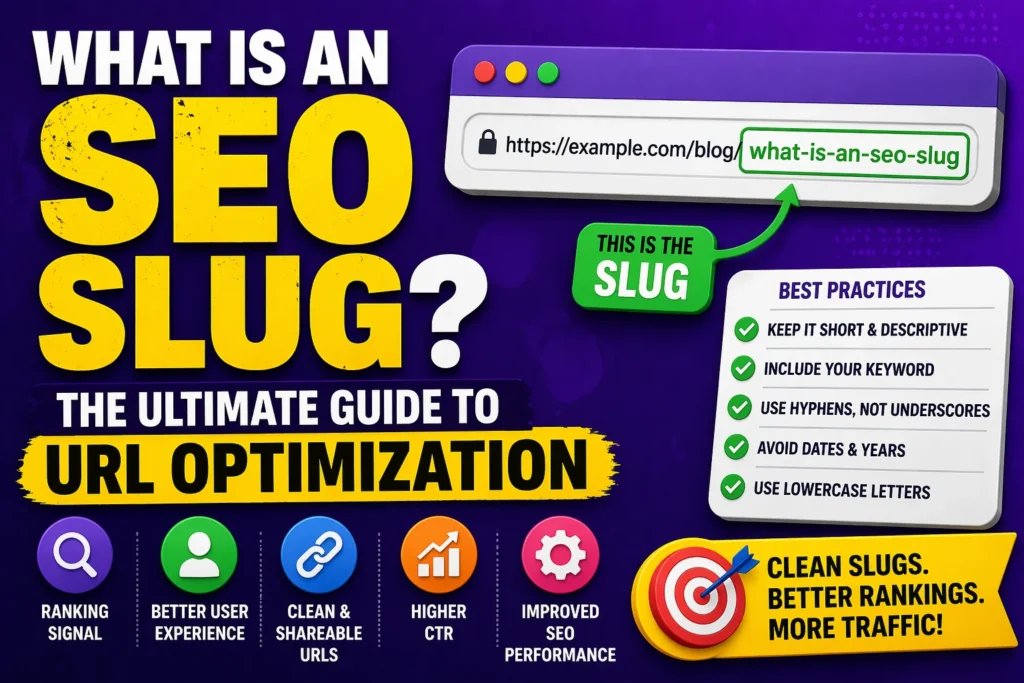
When you visit a website, the URL (Uniform Resource Locator) is the address you see in your browser. An SEO Slug is the specific part of that URL that comes after the final slash (/) and identifies a specific page in a human-readable format.
Example:
In the URL https://example.com/blog/how-to-track-seo, the slug is:
how-to-track-seo
1. Why is the Slug Important for SEO?
While it might seem like a small detail, the slug serves two critical purposes:
A. It’s a Ranking Signal
Search engines like Google use the words in your slug to understand the topic of your page. Including your focus keyword in the slug is a fundamental part of On-Page SEO.
B. It Improves the User Experience (UX)
A clean, descriptive slug tells the user exactly what they are about to click on. A good slug improves your user experience and increases your Click-Through Rate (CTR) in search results and on social media.
2. SEO Slug vs. URL: What’s the Difference?
It’s easy to get these confused. Here is the breakdown:
| Term | Definition | Example |
| URL | The full web address. | https://site.com/what-is-seo-title |
| Domain | The name of the website. | site.com |
| Slug | The specific page identifier. | what-is-seo-title |
3. Best Practices for Creating Perfect Slugs in 2026
To ensure your slugs are optimized for both search bots and humans, follow these rules:
- Keep it Short and Sweet: Aim for 3–5 words. Shorter URLs are easier to share and remember.
- Include Your Primary Keyword: If your blog is about what is Seo copywriting, your slug should be what-is-seo-copywriting.
- Use Hyphens, Not Underscores: Google treats hyphens (-) as spaces, but it sees underscores (_) as part of a word. Always use hyphens.
- Avoid Dates and Years: If you use /blog/seo-tips-2025/, your content looks outdated by 2026. Keep it “evergreen” by just using /blog/seo-tips/.
- Use Lowercase Letters: Some servers are case-sensitive. Using all lowercase prevents broken links and 404 errors.
4. Can You Change a Slug Later?
Yes, but be careful! If you change a slug without setting up a 301 Redirect, you will create a dead link. This leads to 404 errors, which can kill your rankings and waste your backlink authority.
If you are planning a site-wide URL change, it is often best to hire Seo consulting services to ensure your “link juice” stays intact.
📊 Summary Checklist for Slugs
| Feature | Best Practice |
| Keywords | Must include primary keyword. |
| Length | Under 60 characters. |
| Separators | Use hyphens (-) only. |
| Stop Words | Remove words like “a”, “the”, “and”. |
Conclusion
An SEO slug might be at the very end of your URL, but it should be at the front of your mind. By keeping your slugs clean, descriptive, and keyword-focused, you make your website more “readable” for both Google and your future customers
FAQS
Q: Should I put my category in the slug?
Answer: It depends. For large e-commerce sites, categories help with organization. For blogs, a flatter structure (e.g., site.com/slug) is often better for SEO.
Q: Does a slug help with “AI Search”?
Answer: Yes. When using ai for Seo, you’ll notice that AI models like Gemini use the URL structure to verify the relevance of a source. A clear slug helps AI identify your content as a “Source of Truth.”
Q: Do slugs matter for Etsy or Amazon?
Answer: Absolutely. Etsy Seo relies heavily on the title of your listing, which often automatically generates the slug. Making sure your title is keyword-rich ensures your slug is too.

