
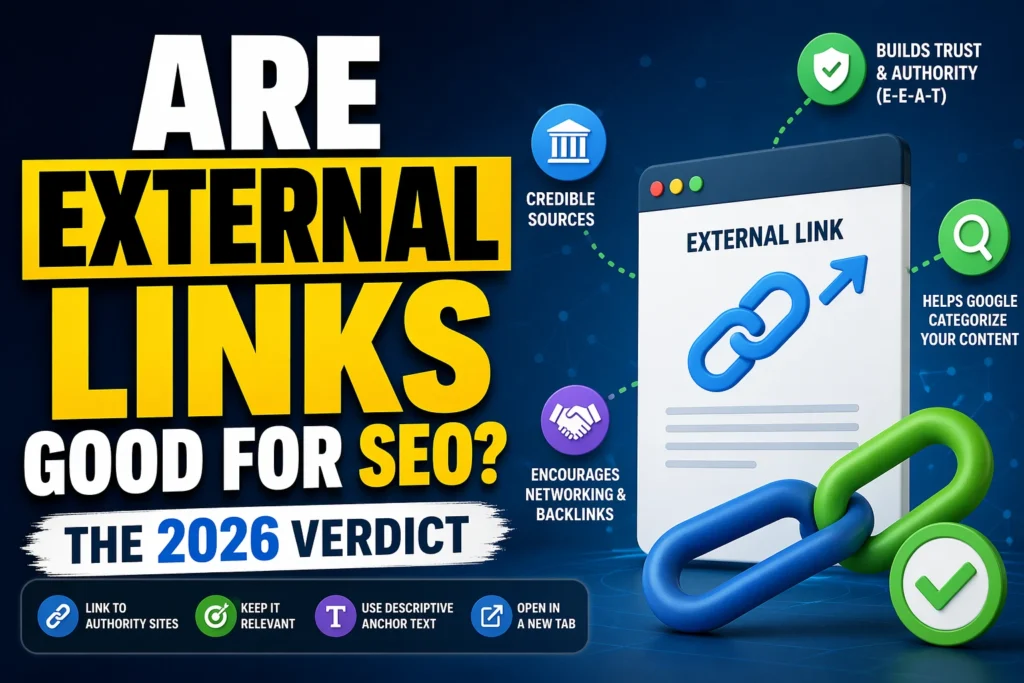
In the world of digital marketing, an External Link (also known as an outbound link) is a hyperlink that points from your website to a different domain.
While internal links help users navigate your site, external links help search engines understand where your website fits in the “knowledge graph” of the internet. According to Google’s E-E-A-T guidelines, linking to high-authority sources is a signal of a high-quality, trustworthy resource.
1. Why External Links Benefit Your SEO
A. It Builds Trust and Authority (E-E-A-T)
If you make a bold claim in your seo copywriting but don’t cite a source, why should Google trust you? By linking to official documentation, university studies, or industry leaders, you show that your content is well-researched and credible.
B. It Helps Google Categorize Your Content
Search engines use external links to figure out your “niche.” If you are writing about how to choose best keywords for seo and you link to reputable SEO journals, Google’s AI more easily identifies your site as an “SEO Authority.”
C. Encourages Networking & Backlinks
Linking out is the first step in off-site seo. When you link to a brand or an influencer, they see that traffic in their analytics. This often leads to relationships, mentions, and eventually, people linking back to you.
2. The Golden Rules of Linking Out
To ensure your external links help (and don’t hurt) your rankings, follow these 2026 best practices:
- Link to Authority Sites: Only link to sites that have high trust (e.g., .gov, .edu, or established industry giants).
- Keep it Relevant: If your blog is about how to promote your website, don’t link to a random cooking blog.
- Use Descriptive Anchor Text: Avoid “click here.” Use descriptive words that tell the user what they are clicking on.
- Open in a New Tab: Always set external links to target=”_blank”. This ensures users don’t completely leave your site when they click.
3. When External Links Can Be “Bad”
There are specific cases where linking out can hurt your reputation:
- Linking to “Spammy” Sites: If you link to low-quality, “Black Hat” websites, Google might associate your site with that neighborhood.
- Broken Links: If you link to a page that no longer exists, you create a bad user experience. Regularly check if broken links affect Seo on your site.
- Overwhelming the Reader: Too many links can be distracting. Focus on quality citations, not quantity.
📊 External Links vs. Internal Links
| Feature | External Links (Outbound) | Internal Links |
| Destination | A different website. | Another page on your site. |
| SEO Goal | Build trust and provide citations. | Improve navigation and “Link Juice.” |
| Best Practice | Link to high-authority sources. | Use a clear anchor text. |
Conclusion
External links are the “citations” of the internet. In 2026, the websites that win are those that act as helpful hubs of information. By linking to great resources, you aren’t losing traffic; you are gaining a reputation as a trusted leader in your field.
FAQS
Q: Will linking to a competitor hurt my rankings?
Answer: Not necessarily. If the competitor has a tool or a specific piece of data that helps your reader, linking to them can actually improve your “Helpful Content” score.
Q: Should I use “NoFollow” for all external links?
Answer: No. Only use rel=”nofollow” for paid links or user-generated content (comments). Regular editorial links should stay “DoFollow” to show genuine trust.
Q: Can a consultant help me with a linking strategy?
Answer: Yes. Seo consulting often includes an audit of your link profile to ensure you aren’t linking to dangerous or irrelevant sites.

