In the early days of the internet, you could rank a page just by repeating your keyword fifty times. Those days are long gone. Today, search engines focus on user intent, authority, and value.
If you want to drive organic traffic that actually converts, you need a data-driven SEO content strategy.
What is an SEO Content Strategy?
An SEO content strategy is the process of planning, creating, and optimizing content with the primary goal of ranking in search engine results pages (SERPs). It’s the bridge between what your audience is searching for and the solutions your business provides.
5 Pillars of a Winning Content Strategy
1. Identify Your Target Audience & Intent
Before you type a single word, you must understand Search Intent. Generally, intent falls into four categories:
- Informational: The user wants to learn (e.g., “How to do SEO”).
- Navigational: The user is looking for a specific site.
- Commercial: The user is researching products (e.g., “Best SEO tools”).
- Transactional: The user is ready to buy.
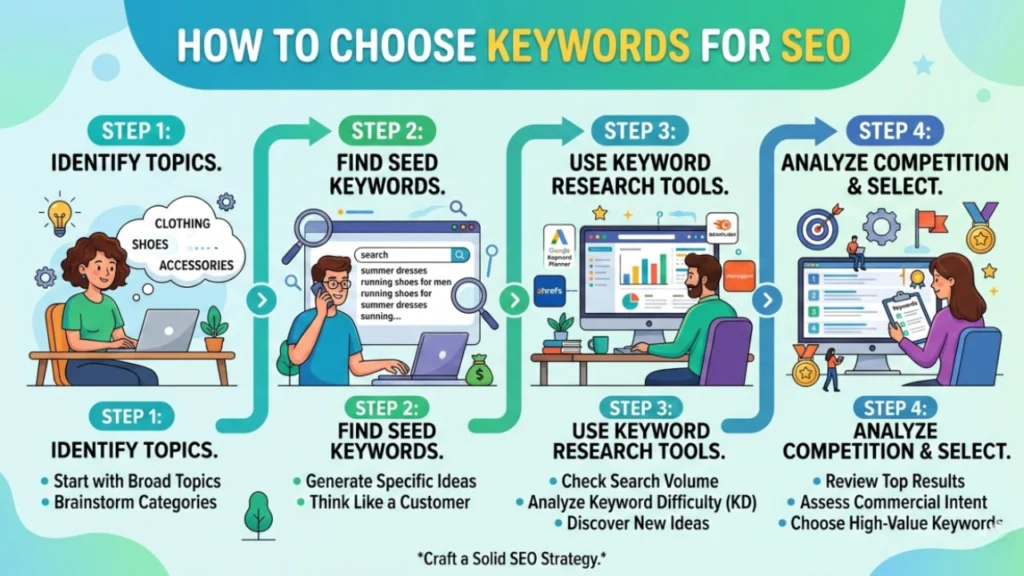
2. Keyword Research (Beyond Search Volume)
High search volume is great, but relevancy is better. Use tools to find:
- Primary Keywords: Your main topic.
- Long-Tail Keywords: Specific phrases that are easier to rank for.
- LSI Keywords: Related terms that help engines understand context.
Deep Dive: Identifying the right terms is an art. For a detailed breakdown, check out our guide on how to choose keywords for SEO to find low-competition opportunities that rank fast.
3. The “Topic Cluster” Model
Search engines now favor topical authority. Instead of writing random posts, organize your content into clusters:
- Pillar Page: A comprehensive guide on a broad topic.
- Cluster Content: Specific blog posts that link back to the pillar page.
4. Optimize for On-Page SEO
To help Google “read” your page, ensure you follow these technical basics:
- Header Tags (H1, H2, H3): Use them to create a clear hierarchy.
- Internal Linking: Link to your other relevant posts.
- Alt Text: Describe your images for accessibility and SEO.
5. Prioritize “E-E-A-T”
Google evaluates content based on Experience, Expertise, Authoritativeness, and Trustworthiness.
- Cite your sources.
- Include author bios.
- Share first-hand experiences or original data.
How to Measure Your Success
A strategy is only as good as its results. Keep an eye on these metrics:
- Organic Traffic: Are more people finding you via search?
- Keyword Rankings: Is your page moving up in the SERPs?
- Bounce Rate: Are people staying to read your content?
- Conversions: Is your content turning readers into leads?
Summary Checklist for Publication
- Primary keyword included in the first 100 words?
- H1 tag contains the primary keyword?
- All images have descriptive Alt-Text?
- At least 2-3 internal links to other site pages?
- At least 1 outbound link to a high-authority source?
- Mobile friendliness checked?
- Schema Markup added?
FAQ
1. How long does it take to see SEO results?
Expect to see significant movement within 3 to 6 months. SEO is a marathon, not a sprint; it requires consistent optimization to build authority.
2. SEO vs. Content Marketing: What’s the difference?
SEO focuses on technical visibility and rankings, while Content Marketing focuses on audience engagement. A good strategy uses SEO to get found and Content Marketing to provide value.
3. How often should I update my content?
Aim for every 6 to 12 months. Refreshing old posts with new data and links tells search engines your information is still accurate and relevant.
4. Does word count still matter in 2026?
Quality beats quantity. While long-form content often ranks better for complex topics, your goal should be to answer the user’s question completely in as few or as many words as needed.
5. What is a “Topic Cluster”?
It’s a group of related web pages. You have one central Pillar Page linked to multiple specific Cluster Posts. This structure proves to Google that you are a topical expert.