
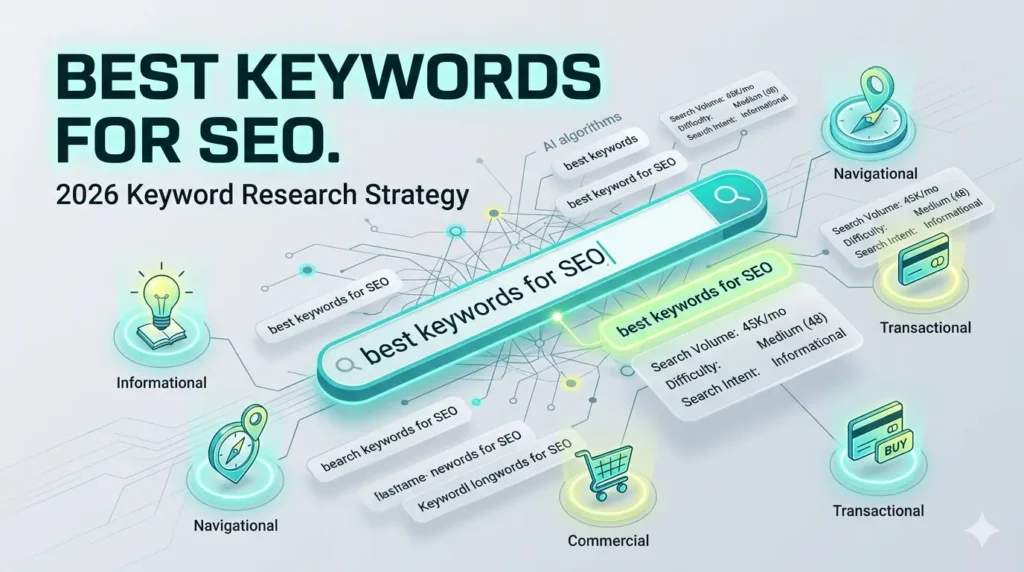
Keyword research is the foundation of your digital house. If you choose the wrong keywords, your content—no matter how good—will never reach the right people. Today, successful SEO is about finding the sweet spot between Relevance, Authority, and User Intent.
1. Start with “Seed” Topics, Not Just Words
Instead of guessing words, identify the core topics your business is an expert in.
- The Strategy: List the problems your service solves. For example, if you offer Seo consulting, your seed topics are “low organic traffic,” “technical SEO errors,” or “site migration help.”
- Pro Tip: Talk to your sales team or check your customer emails. The questions they ask are your best keyword opportunities.
2. Understand the 4 Types of Search Intent
In 2026, Google is an expert at detecting “Intent.” If you target a transactional keyword with an informational blog, you will never rank.
| Intent Type | User’s Goal | Example Keyword |
| Informational | Wants to learn. | “What are rich snippets“ |
| Navigational | Wants a specific site. | “Semrush Login” |
| Commercial | Researching to buy. | “Best SEO tools for beginners” |
| Transactional | Ready to buy NOW. | “Hire SEO expert in Sialkot” |
3. The Power of Long-Tail Keywords
In the age of voice search and AI, over 91% of searches are now long-tail (3+ words).
- Why it works: Short-tail keywords like “SEO” are too competitive. Long-tail keywords like “how to promote your website” have less competition and a much higher conversion rate.
- AI Visibility: AI search engines love long-tail questions because they provide a clear context to answer.
4. Analyze Metrics: Volume vs. Difficulty
Use tools like Ahrefs, Semrush, or Google Keyword Planner to check these two metrics:
- Search Volume: How many people search for this monthly? (Don’t ignore “Zero Volume” keywords if they are highly relevant to your business!).
- Keyword Difficulty (KD): On a scale of 0–100, how hard is it to rank?
- New Sites: Aim for KD 0–30.
- Established Sites: Can target KD 50+.
5. The Competitor “Content Gap”
One of the fastest ways to find the best keywords is to see what your competitors are already ranking for.
- The Move: Use a “Keyword Gap” tool to find words where your competitors are on Page 1, but you aren’t even in the top 100. This is your “Low Hanging Fruit.”
🏗️ SEO Metadata
- Focus Keyword: how to choose best keywords for seo
- Meta Title: How to Choose the Best Keywords for SEO (2026 Intent Guide)
- Meta Description: Stop guessing your keywords. Learn the 2026 strategy for keyword research, including search intent mapping, long-tail discovery, and AI optimization.
- URL Slug: how-to-choose-best-keywords-for-seo
📊 Keyword Selection Checklist
- Is it Relevant? Does this keyword actually relate to what I sell/do?
- Is the Intent Clear? Do I know exactly what the user wants?
- Can I Rank? Is the Keyword Difficulty realistic for my site’s authority?
- Is it Worth It? Will this traffic lead to a lead, a sale, or a brand mention?
Conclusion
Choosing the best keywords is about empathy—putting yourself in the shoes of your customer. In 2026, the winners are those who optimize for the human answer, not just the search bot.
FAQS
Q: Should I ignore keywords with low search volume?
Answer: No! A keyword with only 10 searches a month might be worth $10,000 if those 10 people are ready to buy your high-end service. Focus on Business Value over volume.
Q: Does AI help with keyword research?
Answer: Yes. using ai for Seo can help you find “Semantic” related terms that traditional tools might miss.
Q: How many keywords should I target per page?
Answer: Focus on one primary keyword and 3–5 related “Secondary” keywords. This helps you build unique content that covers a topic deeply without “Keyword Stuffing”.

