
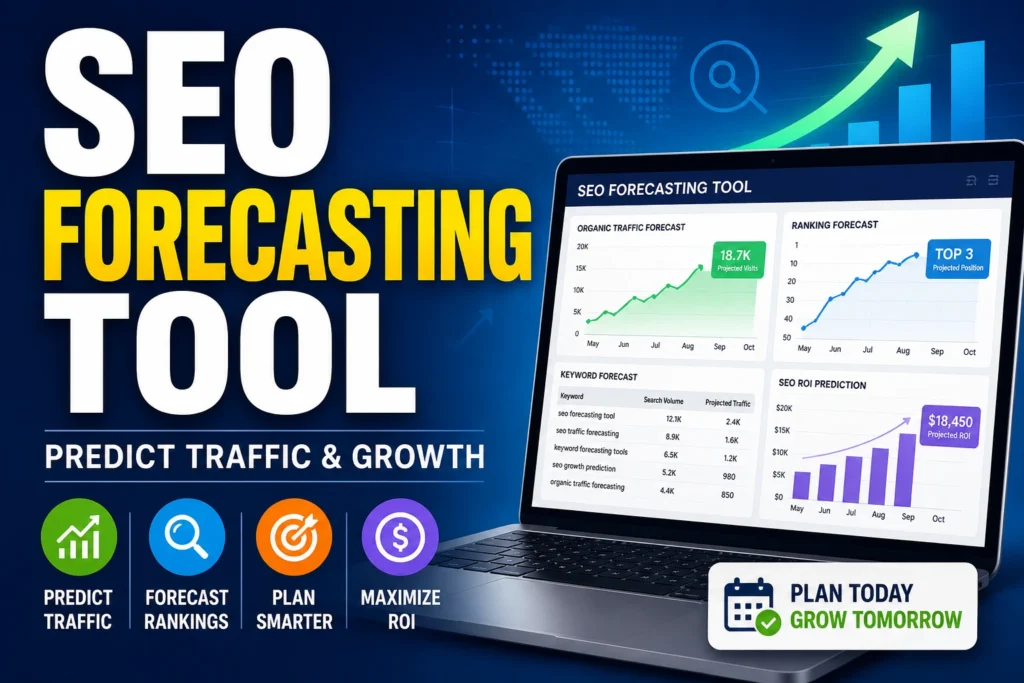
What if you could predict your website traffic before it even happens? That’s exactly what a seo forecasting tool allows you to do. Instead of guessing which keywords will work, you can use real data to estimate rankings, traffic, and even revenue.
In today’s competitive digital landscape, relying on instinct alone isn’t enough. Businesses that win are the ones that plan ahead—and forecasting is the secret weapon behind smart SEO strategies.
In this guide, you’ll learn how a seo forecasting tool works, why it matters, and how to use it to make better decisions that actually drive results.
What Is an SEO Forecasting Tool?
A Seo forecasting tool is a software or method that predicts future SEO performance based on historical data, keyword trends, and search behavior.
It helps answer questions like:
- How much traffic will this keyword bring?
- How long will it take to rank?
- What ROI can I expect from SEO?
Instead of reacting to results, you start planning for them.
Why You Need an SEO Forecasting Tool
SEO takes time. Without forecasting, you’re essentially working blind.
Here’s why using a seo forecasting tool is a game changer:
1. Data-Driven Decisions
No more guessing. You rely on actual numbers and trends.
2. Better ROI Planning
Forecast revenue potential before investing time and money.
3. Smarter Keyword Targeting
Focus only on keywords that can bring measurable results.
4. Stakeholder Confidence
Clients and teams trust projections backed by data.
How an SEO Forecasting Tool Works
Most SEO forecasting tools use a combination of:
1. Search Volume Data
Analyzes how often keywords are searched.
2. Click-Through Rate (CTR) Models
Estimates how many users click based on ranking position.
3. Ranking Predictions
Calculates how likely you are to rank for a keyword.
4. Historical Performance
Uses past data to predict future trends.
Simple Example:
If a keyword has:
- 10,000 monthly searches
- Expected CTR of 20% at position #1
You could estimate 2,000 monthly visits.
Best Ways to Use an SEO Forecasting Tool
1. Keyword Planning
Use a seo forecasting tool to prioritize high-impact keywords instead of chasing everything.
👉 Related strategy: How to Choose Best Keywords for SEO (2026 Intent Guide)
2. Content Strategy
Forecast which blog topics will bring traffic before writing them.
👉 Learn more: SEO & Social Media: How They Work Together in 2026
3. SEO Campaign Planning
Estimate how long it will take to see results and set realistic goals.
4. Revenue Forecasting
Connect traffic estimates with conversion rates to predict earnings.
👉 You can explore analytics insights from sources like
Google Analytics and keyword data from Ahrefs.
Top Features to Look for in an SEO Forecasting Tool
Not all tools are created equal. Here’s what to look for:
- Accurate keyword data
- Traffic prediction models
- Ranking difficulty analysis
- Competitor insights
- Visual dashboards
A good seo forecasting tool should simplify complex data into actionable insights.
Common Mistakes to Avoid
Even the best tools can fail if used incorrectly.
❌ Relying on Forecasts Alone
Forecasts are estimates—not guarantees.
❌ Ignoring Competition
Ranking depends heavily on competitors.
❌ Overestimating CTR
Not all users click the first result.
❌ Skipping Updates
SEO trends change—your forecasts should too.
Real-World Example
Let’s say you run an eCommerce store.
Instead of randomly targeting keywords, you use a seo forecasting tool and find:
- Keyword A → 500 visits/month
- Keyword B → 5,000 visits/month
Both require similar effort.
Which one would you choose?
This is the power of forecasting—it helps you work smarter, not harder.
SEO Forecasting Tool vs Traditional SEO
| Traditional SEO | SEO Forecasting Tool |
| Guess-based decisions | Data-driven planning |
| Reactive strategy | Predictive strategy |
| Slow optimization | Faster, targeted growth |
| Uncertain ROI | Measurable outcomes |
How to Get Started
You don’t need expensive tools to begin.
Start with:
- Google Search Console
- Google Analytics
- Basic keyword research tools
Then move to advanced platforms for deeper forecasting.
FAQ
1. What is the main benefit of an SEO forecasting tool?
It helps predict traffic, rankings, and ROI so you can plan smarter SEO strategies.
2. Are SEO forecasts accurate?
They are estimates based on data. While not perfect, they are far better than guessing.
3. Can beginners use an SEO forecasting tool?
Yes. Many tools offer simple dashboards that are beginner-friendly.
4. How often should I update forecasts?
Ideally every 1–3 months, depending on how fast your niche changes.
Conclusion
SEO is no longer just about optimizing pages—it’s about predicting outcomes.
A reliable seo forecasting tool gives you clarity, direction, and confidence. It helps you invest in the right keywords, create smarter content, and achieve measurable growth.
If you want to stay ahead in SEO, stop guessing and start forecasting.
Because in digital marketing, the future belongs to those who can see it coming.

