
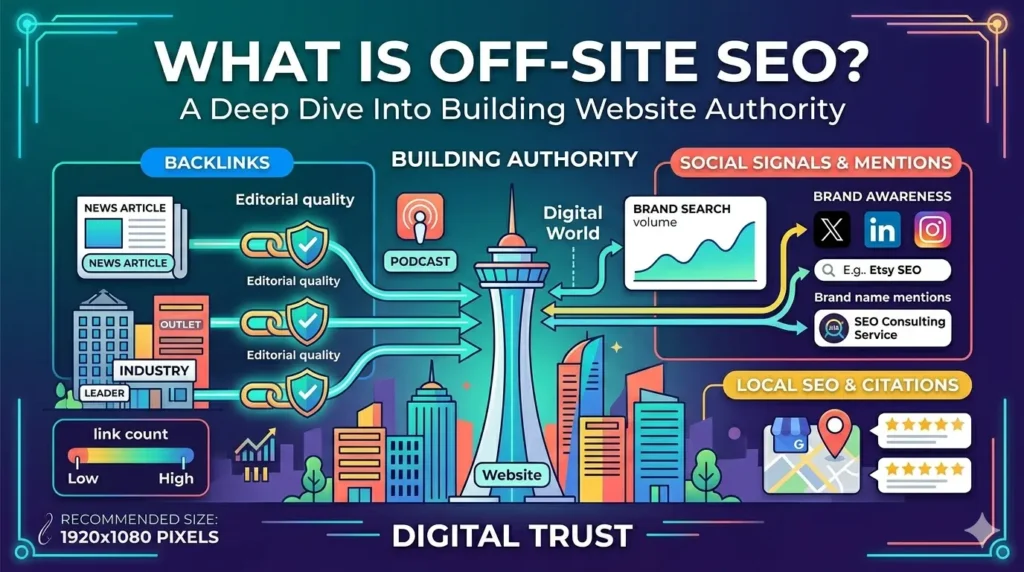
If your website is a candidate running for an election, On-Page SEO is your manifesto, but Off-Site SEO is the number of people who actually vote for you. It is the process of building “digital footprints” that tell search engines like Google and Gemini that your site is a trusted, reputable source of information.
Without a strong off-site strategy, even the most beautiful website will struggle to reach the first page.
1. The Core Pillars of Off-Site SEO
Off-site SEO is primarily about building E-E-A-T (Experience, Expertise, Authoritativeness, and Trustworthiness). Here are the main ways to achieve it:
A. Backlinks: The Currency of the Web
Backlinks are links from other websites to yours. In 2026, Google values “Editorial” links over everything else.
- Quality > Quantity: One link from a high-authority news site or an industry leader is worth more than 1,000 links from unknown blogs.
- Relevance: If you are a tech site, getting a link from a gardening blog doesn’t help. It must be niche-relevant.
- Learn more: Check our guide on how to get backlinks.
B. Social Media Signals
While social media likes and shares aren’t a direct ranking factor, they drive “Brand Awareness.”
- The Logic: When people talk about your brand on Twitter (X), LinkedIn, or Instagram, it increases your “Brand Search” volume. Google sees that people are looking for you by name and boosts your authority.
C. Digital PR & Mentions
Getting mentioned in articles, podcasts, or news outlets (even without a link) is a huge Off-Site signal. Search engines use AI to connect your brand name to specific topics, building your “Topical Authority.”
2. Local Off-Site SEO: Citations & Reviews
For businesses with a physical location, Off-Site SEO is heavily tied to Local SEO.
- GMB (Google Business Profile): Managing your profile is a key off-site activity.
- NAP Consistency: Your Name, Address, and Phone number must be identical across the web (Yelp, Yellow Pages, etc.).
- Reviews: Positive reviews on third-party sites are a major trust signal for both users and bots.
3. Off-Site SEO vs. On-Page SEO: The Comparison
| Feature | On-Page SEO | Off-Site SEO |
| Control | You have 100% control. | You have limited control. |
| Focus | Unique Content & Code. | Building Authority & Trust. |
| Key Metrics | UX, Keywords, Speed. | Backlinks, Reviews, Mentions. |
| OkGoal | Make your site understandable. | Make your site popular. |
4. Common Mistakes to Avoid
- Buying Links: Google’s AI is now an expert at spotting “Link Farms.” Buying cheap links will likely get your site penalized.
- Spamming Comments: Leaving your link in the comment section of random blogs is a dead strategy that can trigger 404 Errors if the links are broken or removed.
- Ignoring Brand Sentiment: If people are talking about you negatively online, it can eventually impact your search visibility.
Conclusion
Off-Site SEO is the “reputation management” side of digital marketing. By focusing on earning high-quality backlinks and maintaining a positive brand presence across the web, you prove to Google that you aren’t just a website—you are an authority.
❓ FAQ: Off-Site SEO
Q: Can I do Off-Site SEO without a blog?
Answer: Yes, through PR and social media, but it is much harder. Having a blog with Anchor Text optimized content gives other people a reason to link to you.
Q: Is “Guest Posting” still part of Off-Site SEO?
Answer: Yes, provided the content is high-quality and the site is relevant. If you’re wondering how to start, a seo consulting service can help you build a safe guest posting roadmap.
Q: Does it help my SEO if I link to others?
Answer: Yes! Outbound Links help build a relationship with other sites and provide context to search engines about your niche.

