
SEO is a long-term investment. Unlike paid ads, you won’t see results overnight. This is why tracking the right metrics is vital—it tells you if your strategy is working or if you need to pivot.
Whether you are focusing on Etsy SEO or a global corporate site, here is the roadmap to monitoring your success.
1. The Essential SEO Tracking Tools
Before you can track, you need the right “detective tools.”
- Google Search Console (GSC): The most important free tool. It tells you exactly which keywords people use to find you and alerts you to technical issues like 404 Errors.
- Google Analytics 4 (GA4): This tracks what happens after a user clicks your link. It measures User Experience (UX) and conversion.
- Ahrefs/SEMrush: Professional tools used for tracking backlinks and monitoring competitor movements.
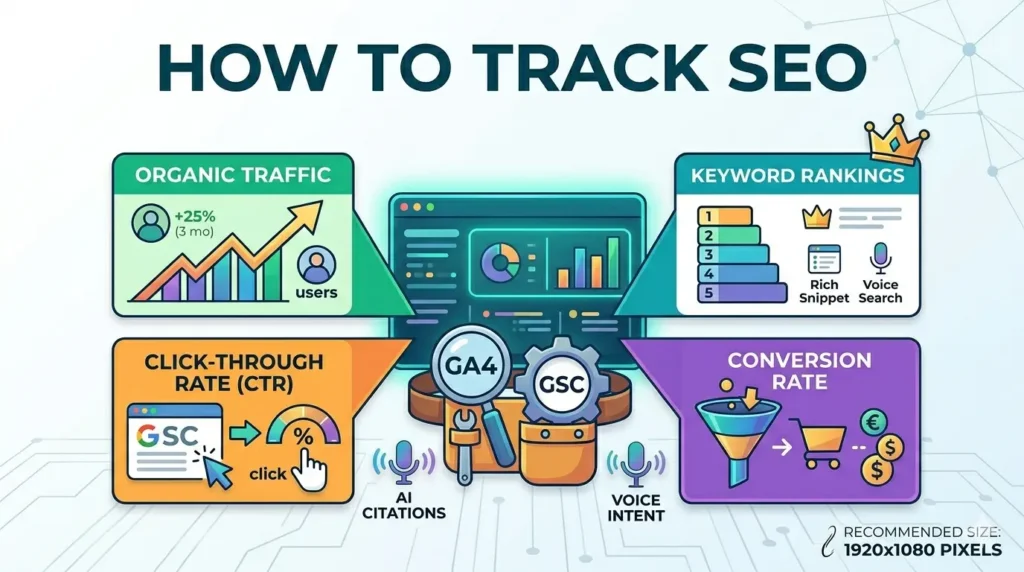
2. Key Performance Indicators (KPIs) to Watch
Don’t get distracted by “vanity metrics.” Focus on these four areas:
A. Organic Traffic
This is the number of visitors coming to your site from search engines. Look for a steady upward trend over 3–6 months.
B. Keyword Rankings & Visibility
Track where your pages sit for your target keywords. Are you moving from page 5 to page 1? Also, track “Share of Voice” to see how often you appear in Rich Snippets compared to others.
C. Click-Through Rate (CTR)
If your rankings are high but clicks are low, your Meta Descriptions or titles might be weak. Tracking CTR helps you refine your “sales pitch” in the search results.
D. Conversion Rate
At the end of the day, SEO must drive business. Track how many organic visitors are signing up for newsletters, calling your business, or buying products.
3. Advanced Tracking in 2026: AI & Voice Search
With the rise of Gemini and SearchGPT, you must now track Brand Mentions.
- AI Citations: Use tools to see if AI search engines are citing your Unique Content as a source.
- Voice Search Intent: Monitor if users are finding you through conversational “long-tail” questions.
4. Setting Up a Monthly SEO Audit
A professional seo consulting service typically performs a monthly check-up. You should do the same:
- Check for “Crawl Bloat”: Ensure Google isn’t wasting time on junk pages.
- Monitor Backlink Health: Are you losing high-quality links? Are you linking out to others via proper Anchor Text?
- Content Refresh: Identify pages where traffic is dropping and update them with fresh data or Outbound Links.
📊 The SEO Tracking Checklist
| Frequency | Task | Tool |
| Daily | Check for critical site errors / crashes. | GSC / Search Console |
| Weekly | Monitor rankings for top 10 keywords. | Semrush / Ahrefs |
| Monthly | Analyze organic traffic & conversion trends. | GA4 |
| Quarterly | Full Technical & Off-Site SEO Audit. | Screaming Frog |
Conclusion
Tracking SEO is about finding the “Why” behind the “What.” When you know which pages are winning and which are losing, you can spend your time Using AI for SEO to scale what works.
FAQs
Q: Why is my traffic up but my sales are down?
Answer: You might be ranking for “Informational” keywords (people just want to learn) instead of “Transactional” keywords (people want to buy). Re-evaluate your intent mapping.
Q: How do I track “Position Zero” (Featured Snippets)?
Answer: Google Search Console’s “Performance” report shows your average position. Any position higher than 1 usually indicates a snippet or an AI overview.

