
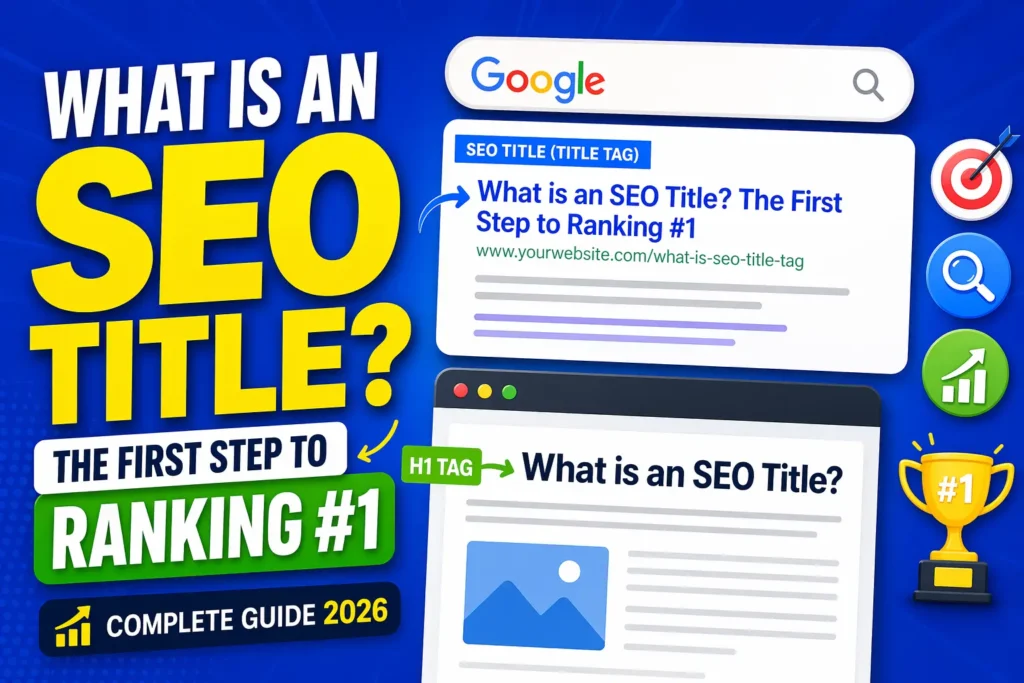
An SEO Title, also known as a Title Tag, is an HTML element that specifies the name of a web page. It appears in three key places:
- Search Engine Results Pages (SERPs): The big blue clickable link.
- Browser Tabs: The text at the top of your browser window.
- Social Media: The default headline when you share a link on platforms like LinkedIn or Facebook.
While it might seem like a small detail, the SEO title is often the deciding factor in whether a user clicks on your site or your competitor’s.
1. Why the SEO Title is Critical for Your Strategy
A. The Primary Ranking Factor
Unlike meta descriptions, the SEO Title is a direct ranking factor. Google uses the words in your title to determine what your page is about. If your target keyword isn’t in the title, ranking for it will be incredibly difficult.
B. Impact on CTR (Click-Through Rate)
The title is your “Headline.” A compelling title attracts clicks, and a high CTR tells Google that your page is relevant, which can lead to even higher rankings.
C. First Impression of UX
User experience starts before the user even reaches your site. A clear, honest title provides a good user experience (ux) by telling the user exactly what to expect.
2. Anatomy of a Perfect SEO Title in 2026
To rank well in the age of AI and mobile-first indexing, follow these specific rules:
- Optimal Length: Keep it between 50–60 characters. Anything longer will be cut off (truncated) by Google.
- Keyword Placement: Place your most important keyword as close to the beginning of the title as possible.
- Brand Name: It is a best practice to include your brand name at the end (e.g., Keyword – Brand Name).
- Avoid All Caps: Using all capital letters looks like spam and can hurt your off-Site seo reputation.
3. SEO Title vs. H1 Tag: What’s the Difference?
Many people confuse the SEO Title with the H1 (Header 1) tag. Here is the distinction:
| Feature | SEO Title | H1 Tag |
| Location | Shows up in Search Results (SERPs). | Shows up on the actual webpage. |
| Purpose | To get users to click from Google. | To welcome users to the page. |
| Code | <title>Your Title</title> | <h1>Your Headline</h1> |
[Image comparing SEO Title Tag in search results and H1 Tag on a webpage]
4. Common Mistakes to Avoid
- Keyword Stuffing: Don’t repeat keywords multiple times (e.g., “SEO Title, Title SEO, SEO Titles Guide”). It looks robotic and can lead to penalties.
- Duplicate Titles: Every page on your site must have a unique title. Duplicate titles lead to “Crawl Bloat” and confuse search engines.
- Ignoring the Intent: If you are writing for etsy seo, your title should be transactional. If it’s an educational blog about what are seo citations, it should be informational.
📊 Title Tag Optimization Checklist
| Step | Action | Why it Matters |
| Step 1 | Include primary keyword. | Direct ranking boost. |
| Step 2 | Check character count. | Prevents truncation on mobile. |
| Step 3 | Use unique content. | Avoids duplicate content issues. |
| Step 4 | Use a Call to Action (CTA). | Encourages more clicks. |
Conclusion
The SEO Title is your website’s handshake—it’s the first interaction a user has with your brand. By keeping it concise, keyword-rich, and relevant, you lay the foundation for a successful SEO strategy.
FAQS
Q: Why did Google change my title in the search results?
Answer: Google sometimes rewrites titles if they feel your original title doesn’t accurately reflect the page content or the user’s query. This is common if your title is too long or keyword-stuffed.
Q: Can I use AI to write my titles?
Answer: Yes! using ai for seo is a great way to brainstorm 5-10 variations of a title and pick the one with the highest emotional hook.
Q: Do title tags affect 404 pages?
Answer: Even your error pages should have a title like “Page Not Found – Brand Name.” To fix these, read our guide on are 404 errors bad for seo.

