
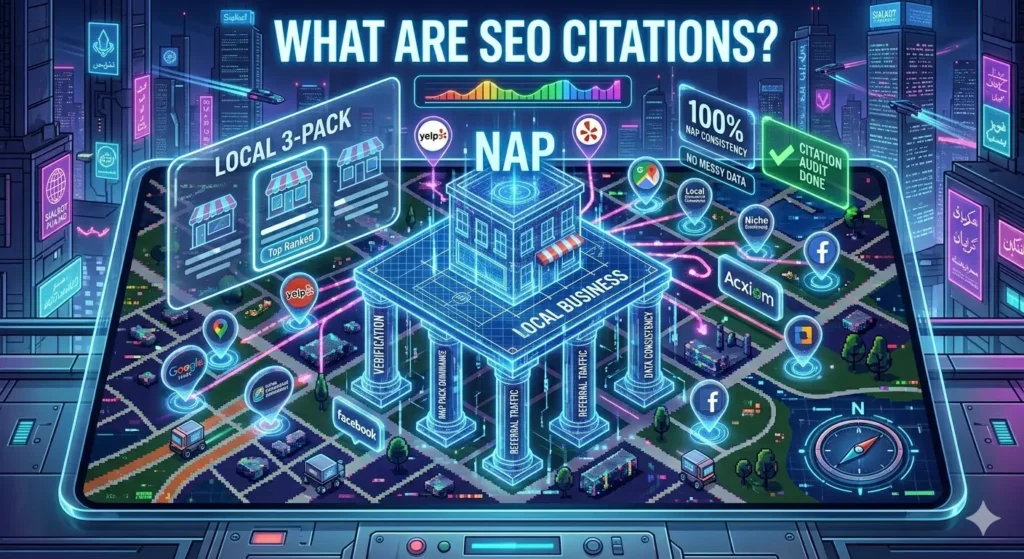
If you have ever searched for a “dentist near me” or a “digital marketing agency near me,” the results you see in the Google Map Pack are heavily influenced by SEO Citations.
An SEO Citation is any online mention of your business’s Name, Address, and Phone number (NAP). Unlike a traditional backlink, a citation doesn’t always need a link to your website to be valuable. Simply being mentioned on a trusted directory tells search engines that your business is real, active, and located where you say it is.
1. The Anatomy of a Perfect Citation
A high-quality citation should always include the “NAP” data, but in 2026, “Rich Citations” are even better. These include:
- Business Name (Legal and consistent)
- Physical Address (Matching your Google Business Profile)
- Phone Number (Local area codes are preferred over toll-free)
- Website URL (Ideally using descriptive anchor text)
- Business Category (e.g., “Handmade Gift Shop”)
2. Why are Citations Critical for Ranking?
Citations serve three primary purposes in a modern SEO strategy:
A. Verification and Trust
Search engines like Google and Bing cross-reference your data across hundreds of sites. If your information is consistent, their confidence in your business grows. If it’s inconsistent, it creates user experience (ux) issues, and your rankings will drop.
B. Dominating the Map Pack
Citations are one of the top ranking factors for the “Local 3-Pack.” The more high-authority directories you appear in, the more “prominence” you have in your local area.
C. Referral Traffic
Directories like Yelp, Yellow Pages, and TripAdvisor get millions of visitors. A citation on these platforms can drive customers to your door even if they never visit your actual website.
3. Types of Citations
- Major Aggregators: Large data hubs like Factual and Acxiom that distribute your info to smaller sites.
- Core Directories: Industry giants like Yelp, Bing Places, and Apple Maps.
- Niche-Specific Directories: Sites dedicated to your industry (e.g., Avvo for lawyers, or etsy seo forums for sellers).
- Geo-Specific Sites: Local chamber of commerce sites or local news blogs.
4. The Golden Rule: NAP Consistency
The biggest mistake businesses make is having “messy” data.
Example: If your address is “Suite 100” on Google but “Ste 100” on Yelp and “Unit 1” on Facebook, Google gets confused.
Conflicting data is as bad for SEO as 404 errors; it signals that your business might be closed or unreliable. Consistency is the key to building off-site Seo authority.
📊 Citation Health Checklist
| Task | Priority | Benefit |
| Audit Existing Citations | High | Finds and fixes inconsistent NAP data. |
| Claim Google Business Profile | Critical | The #1 source of local truth. |
| Remove Duplicates | Medium | Prevents “Crawl Bloat” and confusion. |
| Industry-Specific Links | High | Builds backlinks and niche authority. |
Conclusion
SEO Citations are the “digital references” of your business. In 2026, as search becomes more localized and AI-driven, having a clean and widespread citation profile is non-negotiable. If you want to be the top choice in your city, you need to make sure the internet agrees on who you are and where you are.
FAQS
Q: Do I need a website to have citations?
Answer: Technically, no. You can have citations for a physical store without a site. However, having a site with unique content makes your citations significantly more powerful.
Q: Can I use AI to build citations?
Answer: You can use ai for seo to find directories and write descriptions, but the submission should be checked by a human to ensure 100% accuracy

