
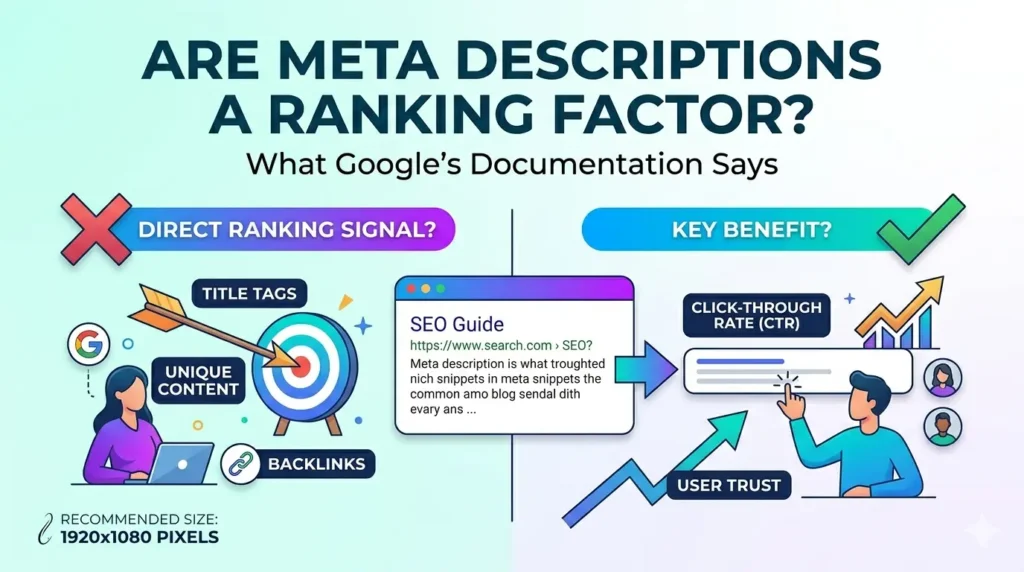
In the high-stakes world of SEO, we often hunt for every possible “ranking signal” to get ahead of the competition. One of the most common debates is whether the Meta Description—the short summary under your title in search results—actually helps you rank higher.
If you’ve been stuffing keywords into your descriptions hoping for a boost, you might be surprised by the official truth.
1. The Official Verdict: No (Directly)
According to Google’s official search documentation (first announced in 2009 and reaffirmed in 2026), Meta Descriptions are NOT a direct ranking factor.
Google’s webmaster trends team has stated clearly:
“Even though we sometimes use the description meta tag for the snippets we show, we still don’t use the description meta tag in our ranking.”
Unlike your Title Tag or your Unique Content, Google does not look at the keywords in your description to decide if your page should be #1 or #10.
2. If They Don’t Help Rankings, Why Use Them?
If they aren’t a ranking signal, why does every SEO expert insist on writing them? The answer lies in Click-Through Rate (CTR).
The “Ad Copy” of Search
Think of your Meta Description as your website’s “Sales Pitch.” If your page appears at #3 and has a compelling, helpful description, users are more likely to click it over the #1 result.
- Indirect SEO Benefit: While the description itself isn’t a factor, the traffic it generates is. Higher CTR signals to Google that your result is relevant to the user’s intent.
Improving User Experience (UX)
A clear description sets expectations. When a user knows exactly what they will find (e.g., a guide on How to Use AI for SEO), they are less likely to bounce. We know that User Experience Affects SEO, so a good description is the first step in a positive user journey.
3. When Google Ignores Your Description
One frustrating part of SEO is that Google often rewrites your description. Official documentation notes that Google will ignore your tag if:
- It is not a good summary of the page.
- It is a duplicate used on multiple pages.
- The user’s specific search query is better answered by a snippet of text found elsewhere on your page.
4. Best Practices for 2026
To make sure your descriptions actually work, follow these guidelines:
- Keep it under 155 characters: Any longer and Google will truncate (cut off) the text.
- Match the Intent: If you are explaining What are Rich Snippets, the description should promise a clear definition.
- Include a Call to Action (CTA): Use phrases like “Learn more,” “Get the guide,” or “Start today.”
- Avoid Keywords Stuffing: Since it’s not a ranking factor, don’t list keywords. Write for humans, not bots.
📊 Summary: Direct vs. Indirect Impact
| Feature | Direct Ranking Factor? | Role in SEO |
| Title Tag | YES | Defines the topic for bots. |
| Meta Description | NO | Boosts CTR and User Trust. |
| Backlinks | YES | Builds Authority. |
| UX/Site Speed | YES | Part of Core Web Vitals. |
Conclusion
According to Google’s documentation, meta descriptions are not a ranking factor—but they are a conversion factor. Don’t write them to please the algorithm; write them to capture the hearts and clicks of your audience.
FAQs
Q: Should I leave the meta description blank?
Answer: Never. If you leave it blank, Google will pull random text from your site, which might include navigation menus or unrelated text, leading to a poor user experience.
Q: Can a bad meta description lead to a 404 error?
Answer: No, but if your description promises something that isn’t on the page, the user will leave. If you have actual broken links, you should check if 404 Errors are Bad for SEO.
Q: Does AI help write better descriptions?Answer: Yes! You can Use AI for SEO to generate multiple variations of a description and then pick the one that sounds most human and persuasive.

