
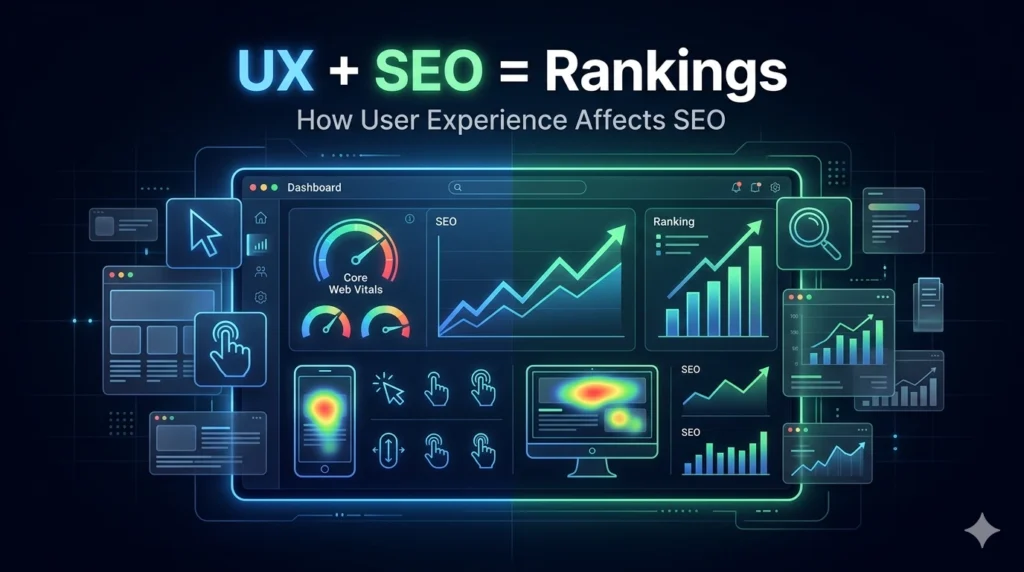
Gone are the days when you could rank a website simply by stuffing keywords and building backlinks. Today, Google’s algorithms—powered by advanced AI like Gemini—prioritize the human element. If your website is a nightmare to navigate, no amount of SEO “magic” will save your rankings.
The relationship is simple: Better UX leads to better SEO. Here is exactly how the two are connected.
1. Core Web Vitals: The Technical Heart of UX
Google’s Core Web Vitals are a set of metrics that measure speed, responsiveness, and visual stability.
- LCP (Largest Contentful Paint): How fast does your main content load?
- CLS (Cumulative Layout Shift): Do buttons jump around while the page is loading?
- The SEO Impact: If your site is slow or unstable, Google will demote you in favor of faster competitors. Speed isn’t just a luxury; it’s a ranking requirement.
2. Dwell Time and Bounce Rate
Search engines use “User Signals” to determine if your page is actually helpful.
- Dwell Time: This is the amount of time a user spends on your page before going back to the search results.
- Bounce Rate: The percentage of users who leave after viewing only one page.
- The Connection: High-quality UX—such as clear headings, engaging Unique Content, and a beautiful layout—keeps users on your site longer. Google sees this “Dwell Time” as a massive vote of confidence.
3. Mobile-First Optimization
In 2026, the majority of global searches happen on mobile devices.
- The UX Factor: Is your menu easy to tap with a thumb? Is the text readable without zooming?
- The SEO Impact: Google uses “Mobile-First Indexing.” If your mobile UX is poor, your desktop rankings will suffer too. UX ensures your site is accessible to everyone, everywhere.
4. Site Architecture and Internal Linking
UX is about how easily a user can find information. SEO is about how easily a bot can crawl your site.
- Seamless Navigation: A well-organized menu helps users find what they need in 3 clicks or less.
- Internal Linking: When you link to a Post Calendar for SEO within a relevant paragraph, you help the user (UX) and pass “link equity” to your other pages (SEO).
5. Trust and Accessibility
A site that looks professional and is accessible to people with disabilities (Screen readers, high contrast) builds Trust.
- E-E-A-T: Google’s AI evaluates the “Trust” of a site based on its design and transparency.
- Conversion: Good UX leads to higher conversions. When users trust your site, they stay, they click, and they buy—all of which are positive signals to search engines.
📊 UX Checklist for Better Rankings
| UX Element | SEO Benefit | Action Step |
| Page Speed | Lower Bounce Rate | Compress images & use WebP. |
| Readability | Longer Dwell Time | Use short paragraphs & bullet points. |
| Secure Site (HTTPS) | Higher Trust Score | Install a valid SSL certificate. |
| Clear CTA | Better Conversion | Use contrasting colors for “Buy/Join” buttons. |
Conclusion:
UX is the “Soul” of SEO. You can get a user to your site with great keywords, but only great UX will keep them there. In 2026, if you want to rank #1, you must stop building for bots and start building for people.
FAQs
Q: Can a beautiful site have bad SEO?
A: Yes. If a site is beautiful but has no keywords, broken links, or 404 Errors, it won’t rank. UX and SEO must work together.
Q: Is “UX Design” the same as “SEO”?
A: No, but they overlap. UX is for the user; SEO is for the search engine. However, Google’s goal is to satisfy the user, so the two are more aligned than ever.
Q: Does “Dark Mode” affect SEO?
A: Indirectly, yes. If your audience prefers dark mode and you provide it, your dwell time may increase, which helps SEO.

