
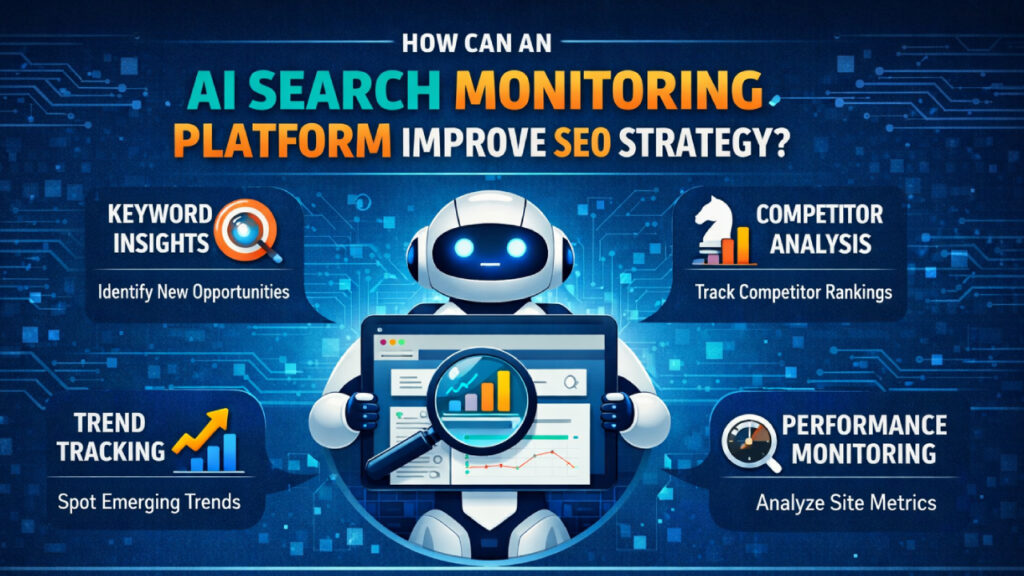
How can an AI search monitoring platform improve SEO strategy? Let’s explore how tracking AI mentions is the next frontier of digital marketing.
The traditional SEO world is fading. In 2026, it’s no longer just about ranking in the “Blue Links.” Today, users are getting direct answers from AI models like Google’s AI Overviews, Perplexity, and ChatGPT. If your brand isn’t being cited as a trusted source by these engines, you are losing visibility.
1. Tracking “Share of Voice” in AI Responses
Traditional SEO tools track your position (1st, 2nd, or 3rd). However, an AI search monitoring platform tracks your “Citation Share” within AI-generated responses.
- Contextual Tracking: These platforms tell you how AI models describe your brand.
- Why it Matters: If an AI identifies your service as “expensive” or “hard to use,” you need to know so you can adjust your content to change that narrative.
2. Identifying “Content Gaps” for AI Training
AI models are trained on massive datasets. If the AI doesn’t have enough clear information about your business, it won’t recommend you to users.
- The Improvement: An AI monitoring platform identifies exactly what information is missing from your site.
- The Fix: By filling these gaps with a Technical SEO Audit Service, you ensure that AI bots can crawl and “digest” your data perfectly.
3. The “Inverted Pyramid” of AI Visibility
An AI monitoring platform helps you visualize your brand’s presence in what experts call the AI Visibility Pyramid. Monitoring helps you climb from the bottom to the top:
- Indexation: Is the AI crawler reading your site?
- Association: Does the AI link your brand to your target keywords?
- Citation: Does the AI mention your brand as a source?
- Recommendation: Does the AI tell users that your product/service is the best choice?
4. Strategic Response to “AI Hallucinations”
In 2026, a major risk is an AI “hallucinating” (giving false information) about your business.
- How Monitoring Helps: If the platform detects that an AI is telling users your business is “permanently closed,” you can immediately update your Schema Markup and Page Speed factors to force a re-crawl.
- Corrective Content: You can then create a dedicated FAQ page to “teach” the AI the correct facts.
5. SEO vs. GEO: A Strategy Comparison
To understand how an AI search monitoring platform improves SEO strategy, we must look at the shift from Search Engine Optimization (SEO) to Generative Engine Optimization (GEO).
| Feature | Traditional SEO Strategy | AI-Driven (GEO) Strategy |
| Primary Goal | Rank #1 in Blue Links | Become the “Featured Answer” |
| Key Metric | Click-Through Rate (CTR) | Attribution & Citation Share |
| Content Style | Keyword-optimized blogs | Question-based, Direct Answers |
| Monitoring Tool | Google Search Console | AI Search Monitoring Platform |
6. Real-Time Reputation and Sentiment Analysis
AI models don’t just provide data; they provide adjectives.
- The Insight: Monitoring platforms analyze the “sentiment” of AI responses. Is the AI calling your affordable SEO services for small business “cheap” (negative) or “high-value” (positive)?
- The Adjustment: If the sentiment is off, you use an AI Content Editor like Surfer SEO to adjust your site’s tone, ensuring the AI “reads” your brand voice correctly.
Conclusion: The Future is Proactive
So, how can an AI search monitoring platform improve SEO strategy? It transforms SEO from a “guessing game” into a data-driven science. It allows you to see your brand through the “eyes” of the AI, giving you the power to influence the answers that your future customers are receiving every day.
FAQs
Q: Will AI Search Monitoring tell me exactly how many clicks I got?
A: Currently, most platforms provide “Estimated Impressions” and “Citation Strength,” as AI models are still refining how they share click data.
Q: Do I need a different strategy for ChatGPT vs. Google AI?
A: Yes. Google priorities web-links and technical health, while ChatGPT priorities conversational logic. Monitoring helps you balance both.
Q: Is there a specific keyword count for AI?
A: No. AI focuses on “Topical Depth.” You should check our guide on how many keywords should I use to understand how to write for AI readability.

