
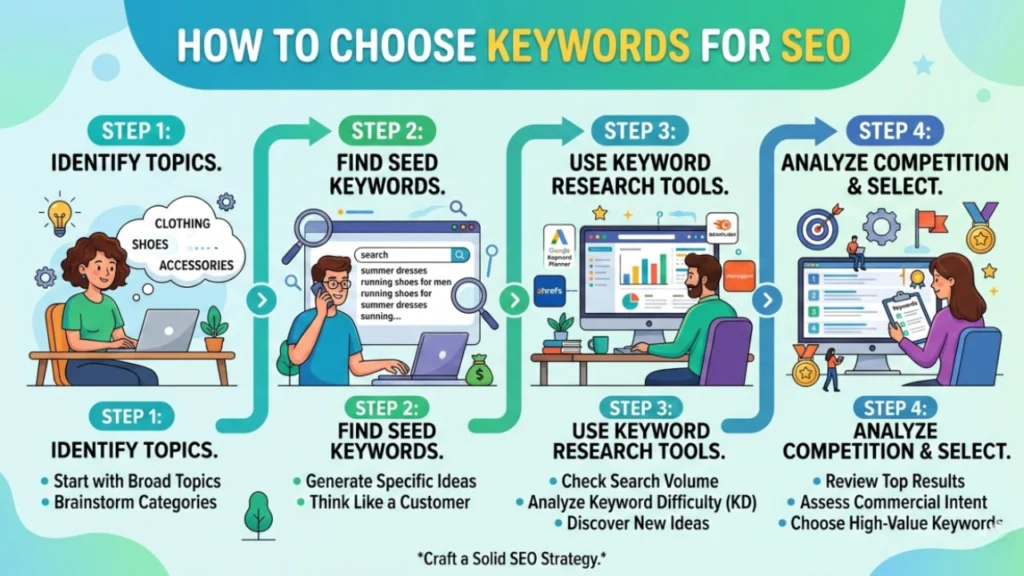
In the modern SEO landscape, ranking isn’t about guessing; it’s about precision. If you target a keyword with the wrong intent or impossible difficulty, you are wasting your most valuable resource: Time.
Whether you are a beginner or a seasoned marketer, this guide will show you how to choose keywords for SEO that don’t just bring “hits”—they bring “business.”
1. The Foundation: Seed Keywords & Brainstorming
Before touching a tool, identify the core pillars of your business.
- Ask: “What problem does my content solve?”
- Action: List 5-10 broad terms. For a marketing blog, these might be SEO, Backlinks, Content Strategy, or Keyword Research.
2. Analyzing the Data (Decoding Your Tools)
When you plug a seed keyword into a tool like Arefs or SEMrush, you’ll see a dashboard similar to the one below. Understanding these numbers is the difference between success and failure.
Key Metrics to Watch:
- Search Volume: How many times the term is searched monthly. (e.g., 2.4K for “how to choose keywords for seo”).
- Keyword Difficulty (KD): A score from 0-100. For new blogs, aim for KD < 30. In our example, a KD of 49 is medium, meaning you’ll need high-quality backlinks to rank.
- Search Intent (The “I” Icon): As seen in your data, the “I” stands for Informational. This tells you the user wants a guide, not a product page.
3. The Keyword Comparison Table
Not all keywords are created equal. Use this table to understand which ones to prioritize for your strategy:
| Keyword Type | Example | Difficulty | Intent | Conversion Potential |
| Short-Tail | SEO | Very High (90+) | Vague | Low (Too broad) |
| Long-Tail | How to choose keywords for SEO | Medium (49) | Informational | Medium (Building Trust) |
| Buying Intent | Best keyword research tool 2026 | High (70) | Commercial | High (Ready to Buy) |
4. The “Keyword Golden Ratio” (KGR) Technique
For 2026, the fastest way to rank a new blog is the KGR method. This helps you find keywords that are underserved by the internet.
The Formula:

- If KGR is < 0.25: You should rank in the Top 50 almost as soon as your page is indexed.
- How to find “Allintitle”: Go to Google and type allintitle: “your keyword”. It shows how many sites have used that exact phrase in their title.
5. Mapping Keywords to Content
Once you have your “Winner” keyword, don’t just write. Map it:
- Primary Keyword: Use in H1, URL, and first 100 words.
- LSI (Latent Semantic Indexing): Use related terms like “Search Volume,” “SEO Tools,” and “User Intent” to help Google understand context.
- Internal Links: Link this new post to your “SEO Content Strategy” pillar page to build topical authority.
❌ Common Mistakes to Avoid
- Chasing Volume Only: Don’t ignore a keyword just because it only has 100 searches. If those 100 people are your perfect customers, it’s a goldmine.
- Ignoring SERP Features: If the top results are all Videos or Images, a text-only blog post might struggle to rank #1.
- Keyword Stuffing: Write for humans first, search engines second.
💡 Pro Tip: The Bigger Picture
Choosing the right keywords is a massive win, but it is only one part of the puzzle. To ensure these keywords lead to long-term organic growth, you must integrate them into a structured SEO Content Strategy. This ensures your content isn’t just a random list of posts, but a powerful engine for your business.
Summary Checklist
- Does the keyword have a clear Search Intent?
- Is the Keyword Difficulty reachable for my site?
- Did I check the “Allin title” count?
- Is the keyword naturally placed in the Title and Metadata?
FAQ
Q: How long should I wait to see rankings?
A: With a low-difficulty long-tail keyword, you can see movement in 4-8 weeks. For high-competition terms, it can take 6+ months
.Q: Can I rank without expensive tools?
A: Yes! Use Google’s “People Also Ask” and “Related Searches” at the bottom of the page to find free keyword ideas.

