
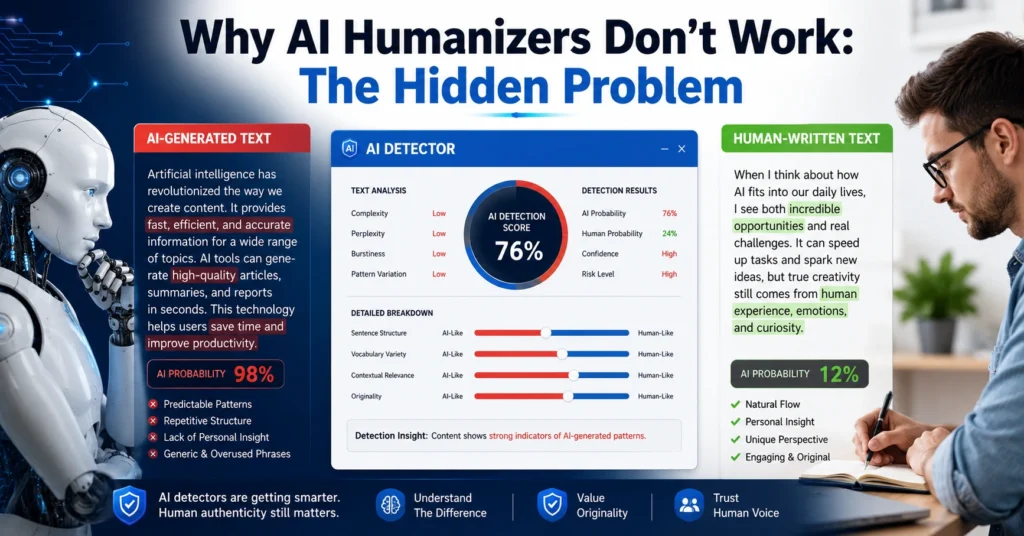
AI writing tools have become incredibly popular. To avoid AI detection, many people now use AI humanizers that promise to make machine-generated text sound more natural. However, many users soon discover that these tools often fail to deliver the results they expect.
If you’ve ever wondered why ai humanizers don’t work, the answer lies in how modern AI detectors and humanization tools actually function. While humanizers can make small changes to text, they rarely create truly human content.
In this article, we’ll explore the biggest reasons AI humanizers struggle and what you should do instead.
What Are AI Humanizers?
AI humanizers are tools designed to rewrite AI-generated content so it appears more natural and less detectable by AI detection software.
They typically:
- Replace words with synonyms
- Change sentence structures
- Adjust grammar and punctuation
- Modify readability levels
The goal is to make AI-written content look like it was written by a person.
Unfortunately, the results are often disappointing.
Why AI Humanizers Don’t Work Effectively
1. They Only Make Surface-Level Changes
Most AI humanizers focus on changing words rather than ideas.
For example, they may replace “important” with “significant” or rearrange sentence order. However, the underlying structure remains the same.
Modern AI detectors look beyond vocabulary and analyze deeper writing patterns, making these simple changes ineffective.
2. AI Detectors Are Becoming Smarter
One major reason why ai humanizers don’t work is that detection tools continue to improve.
Advanced detectors evaluate:
- Predictability of text
- Sentence patterns
- Writing consistency
- Statistical language models
Because of this, even heavily rewritten AI content may still be flagged as AI-generated.
If you’re interested in understanding how these systems work, read our guide on How to Detect AI Generated Text.
3. Humanizers Can’t Create Real Experience
Human writing often includes:
- Personal stories
- Unique opinions
- Real-world examples
- Subject-matter expertise
AI humanizers cannot invent genuine experience. They can only rewrite existing text.
As a result, the content may still feel generic even after being humanized.
This issue is becoming increasingly important as AI-driven search platforms prioritize authentic content. Learn more in our article on What Strategies Improve Brand Visibility in AI Search Engines.
4. Humanized Content Can Sound Unnatural
Ironically, some humanizers make content less human.
Common problems include:
- Awkward phrasing
- Strange word choices
- Inconsistent tone
- Overcomplicated sentences
Readers can often spot these issues immediately.
Instead of improving quality, excessive rewriting may reduce readability and trust.
5. Quality Matters More Than Detection Scores
Many writers focus too much on passing AI detectors.
However, search engines care far more about:
- Accuracy
- Originality
- Usefulness
- Expertise
A low-quality article that avoids detection will not perform as well as a genuinely helpful article.
This is why businesses increasingly focus on AI search optimization rather than AI detection avoidance. For more insights, check out What Are the Best AI Search Optimization Tools.
You may also find our guide on Avoid Copyleaks Saying Text AI useful for understanding common detection challenges.
What Works Better Than AI Humanizers?
Instead of relying entirely on humanization tools, try these strategies:
Add Original Insights
Include your own thoughts, experiences, and examples.
Edit Manually
Review AI-generated drafts and rewrite sections in your natural voice.
Focus on Helping Readers
Create content that solves real problems rather than trying to trick AI detectors.
Use AI as a Starting Point
AI works best as an assistant, not a replacement for human expertise.
What Google Says About AI Content
According to Google, content quality and usefulness are the most important factors. Search engines focus on whether the content is valuable for users or not, rather than just whether it was written by AI.
For more information, see:
Google Search Central – Creating Helpful Content
Google Search Central – AI-Generated Content Guidance
FAQ
Why do AI humanizers fail?
They usually make superficial changes while AI detectors analyze deeper writing patterns.
Can AI humanizers make content undetectable?
No tool can guarantee that content will remain undetectable across all AI detectors.
Does Google penalize AI-generated content?
Google focuses on content quality and usefulness rather than whether AI was used.
Conclusion
Understanding why ai humanizers don’t work is essential for anyone creating content today. Most humanizers only change wording while leaving the underlying AI patterns intact. As AI detectors become more advanced, these tools are becoming less reliable.
Instead of chasing perfect AI bypass methods, focus on creating valuable, original, and helpful content. Human expertise, personal insights, and careful editing remain the most effective ways to produce content that readers and search engines trus.

