
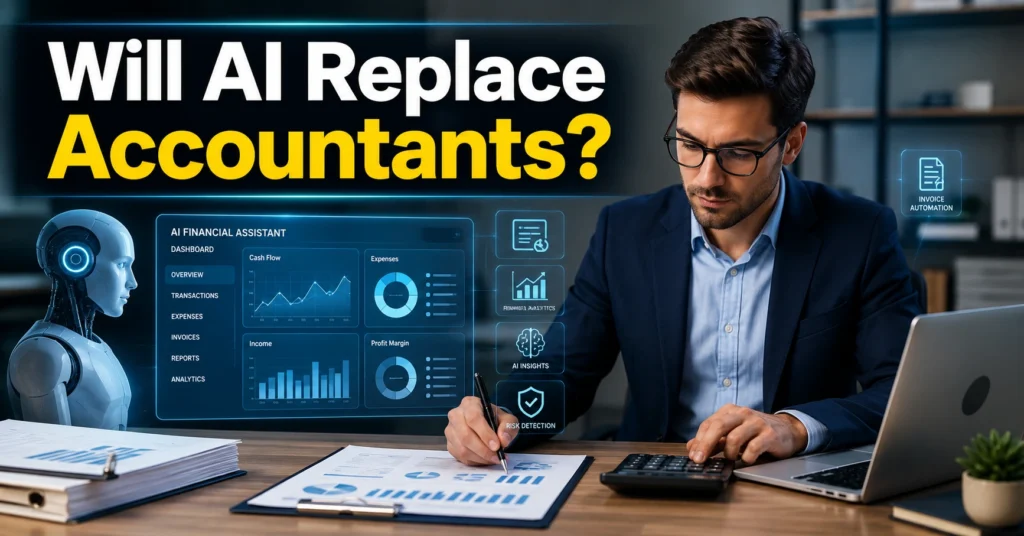
Artificial Intelligence is changing almost every industry. From healthcare to marketing, automation is moving fast. This naturally raises a big question: will AI replace accountants?
Many professionals worry that accounting may become fully automated. After all, AI can process data, analyze transactions, and generate reports in seconds. Some people believe accountants may become unnecessary in the future.
But the reality is more interesting.
AI is definitely transforming accounting, yet replacing accountants completely is a different story. Understanding this difference matters for students, business owners, and finance professionals alike.
What Is AI Doing in Accounting Today?
AI in accounting is no longer a future concept.
Many accounting tools already use automation and machine learning to handle repetitive work.
IBM explains that AI in finance helps automate workflows, improve decision-making, and reduce operational errors across financial systems. IBM AI in Finance Guide
Common AI-powered accounting tasks include:
- Invoice processing
- Expense categorization
- Fraud detection
- Tax calculations
- Data entry
- Financial reporting
- Bank reconciliation
These tools save time and reduce manual errors.
Businesses increasingly rely on smart accounting software because it improves speed and efficiency.
If you are exploring broader AI workplace changes, you may also enjoy Will AI Replace Jobs and What Is Advent AI.
Will AI Replace Accountants Completely?
The short answer is no — at least not completely.
The question “will ai replace accountants” often assumes accounting is only about numbers and spreadsheets. In reality, accounting involves much more.
Accountants do not simply enter data.
They:
- Interpret financial information
- Advise businesses
- Build trust with clients
- Handle complex tax situations
- Make ethical judgments
- Support financial strategy
AI can automate calculations, but it struggles with human judgment and business context.
This is why many experts believe AI will change accounting roles rather than eliminate them.
Tasks AI May Replace First
Although accountants are unlikely to disappear entirely, some tasks are already being automated.
1. Data Entry
Manual bookkeeping is becoming less common.
AI systems can scan receipts, identify transaction categories, and upload records automatically.
2. Routine Tax Preparation
Simple tax filing may increasingly rely on AI software.
Basic returns with predictable patterns require less human involvement.
3. Invoice Matching and Reconciliation
AI can compare records and detect inconsistencies quickly.
This saves hours of repetitive work.
4. Fraud Monitoring
Machine learning tools can identify suspicious financial behavior faster than humans in many cases.
So when people ask will ai replace accountants, the better question may be:
Which accounting tasks will AI replace?
The answer is mostly repetitive and rule-based work.
Why Human Accountants Still Matter
AI is powerful, but accounting involves more than automation.
Human accountants bring qualities technology cannot fully copy.
Strategic Thinking
Businesses often need financial guidance, not just calculations.
An accountant helps owners understand risk, growth opportunities, and long-term planning.
Ethical Judgment
Financial decisions sometimes involve gray areas.
AI follows data patterns, but ethical decisions require human responsibility.
Communication Skills
Clients want explanations.
A business owner facing tax concerns or financial uncertainty often needs clear advice and reassurance.
Machines generate reports.
Humans build relationships.
The Future of Accounting Is AI + Humans
The future is not AI versus accountants.
It is AI plus accountants.
This shift is already visible.
Modern accountants increasingly use AI tools to improve productivity rather than compete against them.
Instead of spending hours on bookkeeping, professionals can focus on:
- Financial consulting
- Advisory services
- Business strategy
- Client relationships
- Risk management
This creates higher-value roles.
Interestingly, this mirrors changes happening in other industries where AI supports professionals instead of replacing them completely.
You may find this related article helpful:
How Does AI Visual Search Work
Real-World Example
Imagine two accounting firms.
Firm A – Traditional Workflow
- Manual spreadsheets
- Long reconciliation time
- High data-entry workload
- Slower reporting
Firm B – AI-Assisted Workflow
- Automated bookkeeping
- Faster reports
- Fraud alerts
- More time for advisory services
Which firm delivers more value?
Usually, the AI-assisted firm.
This example shows why will ai replace accountants is not simply a yes-or-no question.
AI improves accounting processes, but people still provide expertise.
Skills Accountants Should Learn for the AI Era
The accounting profession is evolving.
Professionals who adapt will likely remain valuable.
Important future skills include:
Technology Literacy
Understanding accounting software and AI tools is becoming essential.
Data Analysis
Numbers alone are not enough.
Accountants increasingly need analytical thinking.
Communication
Advisory roles require strong client interaction.
Business Strategy
Financial insight matters more than data entry.
Learning AI-related tools can also help professionals stay competitive. Articles like How to Make an AI and What Strategies Improve Brand Visibility in AI Search Engines highlight how AI skills are growing across industries.
What Experts Say
Major financial and technology organizations generally agree on one idea:
According to the World Economic Forum’s Future of Jobs research, AI and automation are expected to reshape many industries, but most jobs will evolve rather than disappear entirely. World Economic Forum Future of Jobs Report
AI will transform accounting but is unlikely to eliminate accountants entirely.
High-authority sources discussing AI and workplace transformation include:
- World Economic Forum
- IBM AI Resources
These discussions consistently point toward job evolution rather than total replacement.
FAQ
Will AI replace accountants in the future?
AI will automate many accounting tasks, but complete replacement is unlikely. Human expertise, judgment, and advisory work remain important.
Which accounting jobs are most at risk from AI?
Routine bookkeeping, data entry, and simple tax preparation face the highest automation risk.
Should accounting students worry about AI?
Students should focus on learning technology and advisory skills. AI knowledge can actually increase career opportunities.
Can AI do taxes better than accountants?
AI can handle simple tax calculations efficiently, but complex tax planning often requires experienced professionals.
Conclusion
So, will ai replace accountants?
Probably not in the way many people fear.
AI is reshaping accounting and automating repetitive work. Some traditional tasks may disappear, but the profession itself is evolving rather than dying.
The accountants who embrace AI may actually become more valuable.
Instead of competing with machines, the future belongs to professionals who know how to work alongside them.
Accounting is changing — and for adaptable professionals, that change may create more opportunities than threats.

